| |
Join thousands of subscribers to myADHD.com and use our assessment and tracking tools to send rating scales electronically. See what our subscribers are saying about using myADHD.com tools. View testimonials.
See this month's free myADHD.com tools below.
Advertisement |
|
www.ADHDSupportCompany.com
|
Supporting the awareness, treatment, and management of Attention-Deficit/Hyperactivity Disorder by connecting parents, patients, professionals, friends and family with customized tools, information, and resources |
|
Health Canada Suspends Sales of Adderall XR
On February 9th Canadian health officials said they were suspending the sale of Adderall XR indefinitely because the drug was linked to 20 deaths, including 12 children. Health Canada instructed the manufacturer of Adderall XR to withdraw the drug from the Canadian market.
Adderall XR is approved in the United States for the treatment of adults and pediatric patients 6 years of age and older with ADHD. Adderall, the immediate-release formulation of the drug, is approved for pediatric patients with ADHD.
The Food and Drug Administration (FDA) has been aware of these post-marketing cases and evaluated the risk of sudden death with Adderall prior to approving the drug for treatment of ADHD in adults last year. Following Health Canada's decision, the FDA said it is not taking any steps to block the sale of Adderall XR in the US. See the FDA's statement issued February 9th.
Adderall XR and its short-acting preparation, Adderall, are mixed amphetamine salts, which are known to be effective as a treatment for ADHD. Like other stimulants, Adderall and Adderall XR can cause side effects like sleeping problems, appetite loss and irritability as well as slight increases in blood pressure and heart rate among other less common side-effects. The drugs are not recommended for some people with heart problems.
The number of cases of sudden deaths reported for Adderall is only slightly greater, per million prescriptions, than the number reported for methylphenidate products, which are also commonly used to treat pediatric patients with ADHD. Approximately 30 million prescriptions of Adderall products were written between 1999 and 2003 (the period of time in which the deaths occurred). This morning, an article in The Washington Post reported that Joseph Biederman, MD, chief of pediatric psychopharmacology at Massachusetts General Hospital, did not believe there was enough data to link the deaths with Adderall XR. It does not appear that the number of deaths reported is greater than the number of sudden deaths that would be expected to occur in this population without treatment (approximately 10 per million). This is apparently the reason the FDA has not decided to take any further regulatory action at this time.
In August 2004 the labeling for Adderall XR was changed to include a warning that patients with underlying heart defects might be at increased risk for sudden death and that these patients should ordinarily not be treated with Adderall products. Shire
lists additional safety information on the Adderall web site and indicates that people should not take Adderall XR if they:
-
have cardiovascular disease, such as disorders of the heart and blood vessels, including high blood pressure
are allergic to amphetamine or to any of the other ingredients in Adderall XR
-
have glaucoma (an eye disease) or hyperthyroidism
-
have significant anxiety or agitation
-
have a history of psychosis, hallucinations, or drug abuse
-
are taking a MAO inhibitor or have taken one within the past 14 days
In a press release (February 9th) Shire Pharmaceuticals Group indicated that they are complying with Health Canada's request to suspend marketing of Adderall XR in Canada but they strongly disagree with the conclusions drawn by Health Canada. Matthew Emmens, Shire Chief Executive Officer, commented: "We are surprised by this action from Health Canada. Shire remains confident in the safety and efficacy of Adderall XR."
Clinicians across Canada are coming up with alternative drug therapies to treat ADHD according to an article in the CBC Health & Science News published February 14th. They have been getting calls from anxious parents wondering what to do. Dr. Kathy Bigsby, a Prince Edward Island pediatrician indicated that "For families where the switch to Adderall was made because they were having significant problems with other medication, we really have to sit down with them and say, 'what kind of combination strategies are going to work well with your child?'" She said that Adderall was a better drug for some because it could be taken once a day, and the capsule could be opened and sprinkled on food. Clinicians will have to rely on other medications or combinations of therapies, which for some children with ADHD may have been less effective.
The marketing and availability of Adderall XR in the United States is unaffected. Patients who have any concerns about the safety of these medications should consult their physician.
 |
Love in the Fast Lane
by Bob Seay
This article was contributed to MyADHD.com News by
Additude Magazine |
Inattention and distractibility can bring a blast of cold water to an otherwise steamy relationship. By definition, being intimate with another person requires focus. Sharing something deeply personal with someone who seems to not be paying attention is frustrating. Inattention and distractibility can bring a blast of cold water to an otherwise steamy relationship.
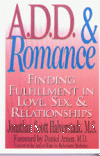
Jonathan Scott Halverstadt, author of the book, ADD and Romance (Taylor Publishing, 1998), says that for many couples what is missing is a sense of connection. "Spouses often tell me their AD/HD partner doesn't seem to really 'be there' during sex," says the psychotherapist from Fairfield, California. One of Halverstadt's clients said that it felt as if her husband didn't care who was there with him during sex. The sense of connection was missing. AD/HD people go from unfocused to hyper-focused, which may sound like a good alternative to the distracted partner. But too much focus can cause it’s own set of problems. Hyper-focusing on your own wants and needs can leave your partner feeling used and empty. Regaining that connection can mean the difference between living happily ever after and sleeping on the couch. The first step is in trying to find what is creating the problem.
For the Partner Who Has AD/HD
If possible, try being with your partner when your medications are still working. Stimulants increase focus and decrease potential distraction. Medication can also help you to be more attentive to your partner. One possible side effect of stimulant medication is trouble sleeping, and many AD/HD people find that they can't take Ritalin or other stimulants late at night if they intend to get any sleep. You could try taking your last dose of medication later in the day, so that it is still effective during the evening but wears off in time for you to get to sleep. Another possibility is to do your lovemaking in the morning. This may be difficult if your morning schedule is already hectic, but at least you’ll show up for work with a smile on your face.
Other medications, particularly antidepressants, can delay orgasm (which may be a good thing in men) or make climax completely impossible (a bad thing for anyone). Sexual problems caused by medications are the most common reason why people discontinue antidepressant medication that's working. Other medications may also affect sexual performance or libido. But don't write off your sex life because you take medications. Instead, find a medication or treatment that allows you and your partner to have a healthy relationship. Sex is like oxygen - you don't really appreciate it until you don't have any. Think about that the next time you take a deep breath. Hyperactive Sex
Going at it liked greased ferrets in heat may sound like fun, but it may leave your partner wondering what happened. "From an evolutionary point of view, fast is better," says sex researcher Robert Birsch, PhD. "You didn't want to be causing a lot of commotion in the bush in case a saber-toothed tiger was around." Unfortunately, any benefits that might have been gained from perpetually quick and intensely focused sex, such as survival of the species, no longer require quite the same sense of urgency. Learning to slow down the pace and to spend time talking - before, during and after sex - may help your relationship survive.
"Slowing down" means more than simply slowing the physical pace of sex. You also have to slow down your mind. That may require some creative thinking. "When I'm having sex, I think about baseball scores," said one ADDitude reader. "Of course, now when I watch baseball, I think about sex. No wonder I'm confused." Instead of thinking about a designated hitter or runs batted in, Halverstadt recommends more focused thoughts. "Tell your lover a bedtime story. It may be something you make up. It may be sexy, romantic, funny or just plain silly. If you've got a lot of courage, act out the story as a play at the foot of the bed with you as the only actor." The point is to become more aware of the physical and emotional needs of your partner. Rather than thinking of sexual intimacy as only intercourse or other climax-inducing activities, try including time to talk, touch and explore your partner’s body, mind and spirit.
 |
Click here for other great articles on ADHD from ADDitude Magazine!
|
Free Teleconference • March 9, 2005, 8:30-9:30 PM
MyADHD.com and ADDvisor.com invite you to sign up for our next free live ADHD teleconference.This free teleconference entitled Helping People with ADHD and Related Conditions features Thomas E. Brown, Ph.D. This is an important topic as so many children and adults with ADHD have additional diagnoses such as depression, anxiety, learning, or behavior problems. Dr. Brown is a clinical psychologist and maintains a private practice in Hamden, Connecticut. He is an Assistant Clinical Professor of Psychiatry at the Yale University school of Medicine , Associate Director of the Yale Clinic for Attention and Related Disorders in Adults.
February's Featured myADHD.com's Tools
Adults with ADHD can benefit from using this month's treatment tools to learn more about workplace accommodations and budgeting personal finances.
• 1201 Personal Budget Worksheet
• 1202 Monthly Budget Worksheet
• 1203 Requesting Workplace Accommodations
• 1204 Workplace Accommodation Ideas
Visit myADHD.com today, register, and view our collection of over 150 tools to assess and treat ADHD and related conditions in children, adolescents and adults. If you like what you see please consider subscribing to this new web-based service for ADHD.
Need to fulfill your continuing education requirements?
See the National Association for Continuing Education for home study programs and live conferences. Over 80 home study courses for psychologists, social workers, marriage and family counselors, and mental health counselors.
For additional articles and resources on ADHD visit these sites:
myADHD.com online library:
www.myadhd.com/librarytools.html
A.D.D. WareHouse—See our special sales for February 2005
www.addwarehouse.com
To sign up for a live conference on ADHD visit www.addconsults.com
Children and Adults with Attention-Deficit/Hyperactivity Disorder (CHADD)
www.chadd.org
Attention Deficit Disorder Association (ADDA)
www.add.org
Subscribe to Attention Research Updates for a free newsletter.
myADHD.com news is an e-publication of Health Link Systems, Inc. This publication is sponsored by myADHD.com, A.D.D. WareHouse, and the National Association for Continuing Education. Information presented here is not intended to replace the advice of a physician or other health care professional. Placement of an advertisement in this e-newsletter does not represent an endorsement of any advertised products or services or the validity of any claims advertised. Copyright 2005 by Health Link Systems, Inc. For comments or information, please send an email to: info@myadhd.com, subject line: myADHD.com News.
|